

Teeth Numbers and Names; Ever wondered why your dentist refers to your teeth by numbers instead of names? Or maybe you’ve tried to explain which tooth is bothering you, only to point vaguely at your mouth? Understanding how teeth are numbered and named isn’t just useful it empowers you to communicate better with your dental team and take charge of your oral health.
Whether you’re planning cosmetic adjustments to brighten your smile or trying to pinpoint exactly where that nagging toothache is coming from, knowing your teeth by name and number makes everything easier. We believe that informed patients are happier, healthier patients. So let’s dive into the fascinating world of dental anatomy and decode the mystery behind your teeth.
Why Knowing Your Teeth Numbers and Names Matters
You might think teeth are just teeth, but each one has a specific job, position, and identity. When you understand how dentists identify and refer to your teeth, you can:
- Communicate discomfort more clearly during appointments
- Understand treatment plans when your dentist explains procedures
- Ask better questions about your oral health
- Feel more confident discussing dental insurance and coverage
- Track your dental history more accurately
Think of it like knowing the parts of your car. You don’t need to be a mechanic, but knowing the difference between your brake pads and your transmission helps you understand what needs fixing.
Teeth Names: What Each Tooth Does in Your Mouth
Your mouth is brilliantly designed. Each tooth type has evolved to perform a specific function in the eating process. Let’s break down the anatomy of a complete adult smile.
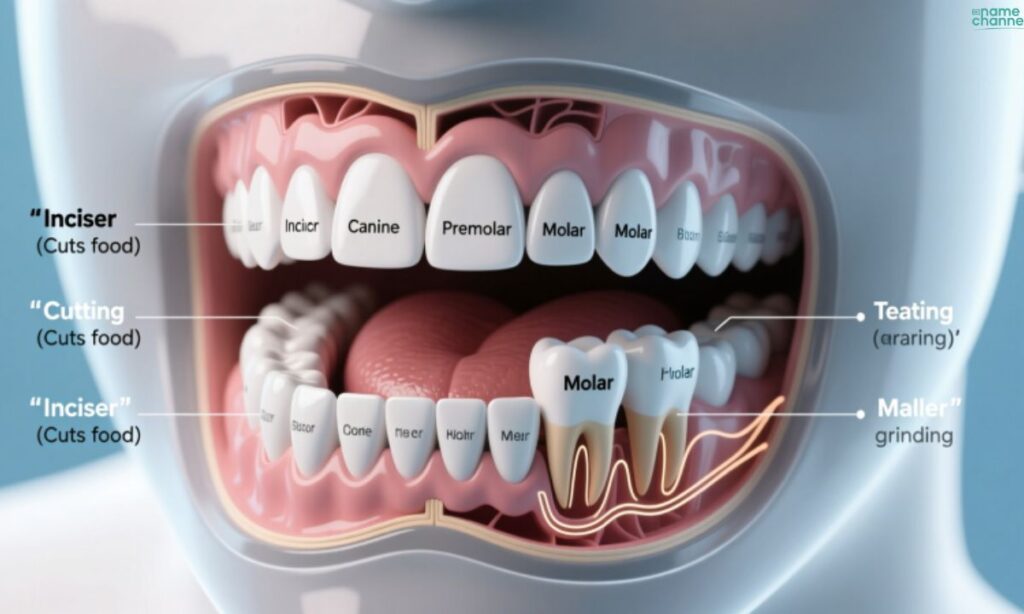
The Four Quadrants of Your Mouth
Your mouth can be divided into four essentially symmetrical parts, or quadrants:
- Upper right (from your perspective)
- Upper left
- Lower left
- Lower right
Each quadrant contains the same types of teeth, creating a balanced, functional bite. A typical adult mouth has 28 to 32 teeth depending on whether wisdom teeth are present.
Incisors: Your Cutting Tools
At the front of your mouth, you have 8 incisors total:
- (4) Central incisors – These are your front teeth, the most visible when you smile. They’re flat and sharp, designed for biting into food like apples or sandwiches.
- (4) Lateral incisors – Positioned right next to your central incisors, these smaller teeth assist with biting and cutting.
Incisors are your smile’s showpieces. They’re the teeth most people notice first, which is why cosmetic dentistry often focuses on these front teeth.
Canines: Your Gripping and Tearing Teeth
In the corners of your smile, you have (4) canines. These are the pointy teeth that look a bit like fangs. Canines are designed for:
- Holding food in place
- Tearing tougher foods like meat
- Guiding your jaw into proper alignment when you bite
Your canines are some of the strongest teeth in your mouth, with the longest roots of any tooth.
Premolars: Your Crushing Assistants
Next to the canines, you’ll find your premolars (also called bicuspids):
- (4) First premolars – Located right behind your canines
- (4) Second premolars – Positioned behind the first premolars
Premolars have a flatter surface with ridges, making them perfect for crushing and grinding food into smaller pieces. They’re the transitional teeth between your sharp canines and flat molars.
Molars: Your Heavy-Duty Grinders
At the back of your mouth, you have your molars—the workhorses of your bite:
- (4) First molars – Often called your “6-year molars” because they typically emerge around age 6
- (4) Second molars – Usually appear around age 12, earning them the nickname “12-year molars”
- (0-4) Third molars (wisdom teeth) – These may or may not erupt, and many people have them removed
Molars have large, flat chewing surfaces with multiple cusps (points) that make them incredibly efficient at grinding food into a consistency that’s easy to swallow and digest.
Teeth Numbers: How Dentists Count Your Teeth
Most adults have at least 28 to 32 permanent teeth. Dentists use a standardized numbering system to identify each tooth quickly and accurately. This universal system ensures that your dental records are clear, consistent, and easily understood by any dental professional.
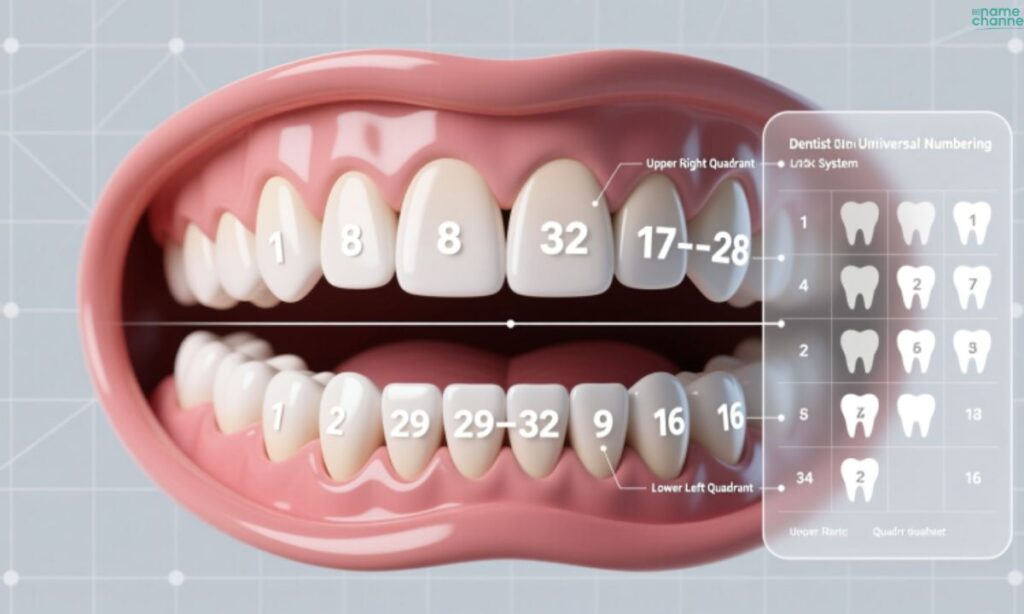
The Universal Numbering System Explained
Here’s how dentists number your teeth:
Starting point: Tooth #1 is your upper right third molar (wisdom tooth area)
Counting method: Dentists count clockwise around your mouth when looking at you face-to-face
Ending point: Tooth #32 is your lower right third molar (wisdom tooth area)
Complete Teeth Numbering Breakdown
Upper Right Quadrant (Teeth #1-8):
- #1: Third molar (wisdom tooth)
- #2: Second molar
- #3: First molar
- #4: Second premolar
- #5: First premolar
- #6: Canine
- #7: Lateral incisor
- #8: Central incisor
Upper Left Quadrant (Teeth #9-16):
- #9: Central incisor
- #10: Lateral incisor
- #11: Canine
- #12: First premolar
- #13: Second premolar
- #14: First molar
- #15: Second molar
- #16: Third molar (wisdom tooth)
Lower Left Quadrant (Teeth #17-24):
- #17: Third molar (wisdom tooth)
- #18: Second molar
- #19: First molar
- #20: Second premolar
- #21: First premolar
- #22: Canine
- #23: Lateral incisor
- #24: Central incisor
Lower Right Quadrant (Teeth #25-32):
- #25: Central incisor
- #26: Lateral incisor
- #27: Canine
- #28: First premolar
- #29: Second premolar
- #30: First molar
- #31: Second molar
- #32: Third molar (wisdom tooth)
Why This Numbering System Matters
This method of numbering allows for fast, accurate, and consistent identification of teeth for medical use between your healthcare providers. Whether you’re seeing a new dentist, filing an insurance claim, or discussing treatment with a specialist, tooth numbers create a common language everyone understands.
Imagine your dentist says, “We need to address tooth #19.” Now you know they’re talking about your lower left first molar—no confusion, no guessing.
Visual Guide: Understanding Your Teeth Layout
Picture your teeth arranged in a horseshoe shape. The numbering flows smoothly from one tooth to the next, making it logical once you understand the pattern.
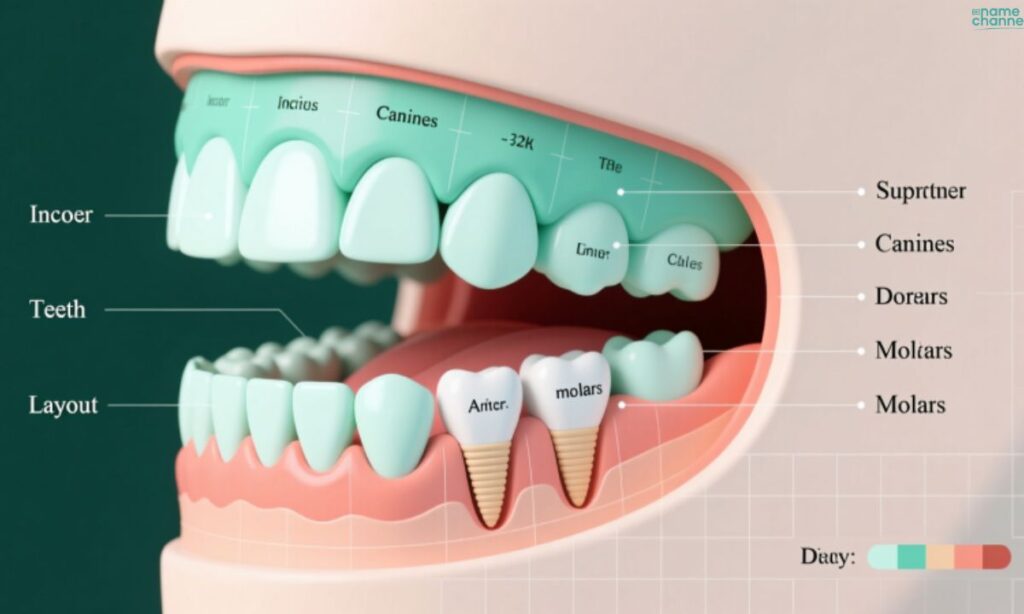
Quick memory tip:
- Teeth #1-16 are all in your upper jaw
- Teeth #17-32 are all in your lower jaw
- The numbers increase as you move clockwise around your mouth
Your central incisors (front teeth) are #8 and #9 on top, #24 and #25 on the bottom—right in the middle of the numbering sequence for each jaw.
Common Dental Scenarios Using Teeth Numbers
Understanding teeth numbers helps you make sense of common dental situations:
Cavity filling: “We’ll need to fill tooth #3” = Your upper right first molar needs work
Root canal: “Tooth #30 needs a root canal” = Your lower right first molar requires treatment
Extraction: “We recommend removing teeth #1, #16, #17, and #32” = All four wisdom teeth should be extracted
Crown placement: “We’ll place a crown on tooth #19” = Your lower left first molar needs a protective cap
Cosmetic work: “We can whiten teeth #6-11” = Your front upper teeth can be brightened
Baby Teeth vs. Permanent Teeth: What’s the Difference?
Children have 20 primary (baby) teeth instead of 32 permanent teeth. These smaller teeth are numbered differently—usually with letters (A-T) instead of numbers, or a different numbering system (51-85).
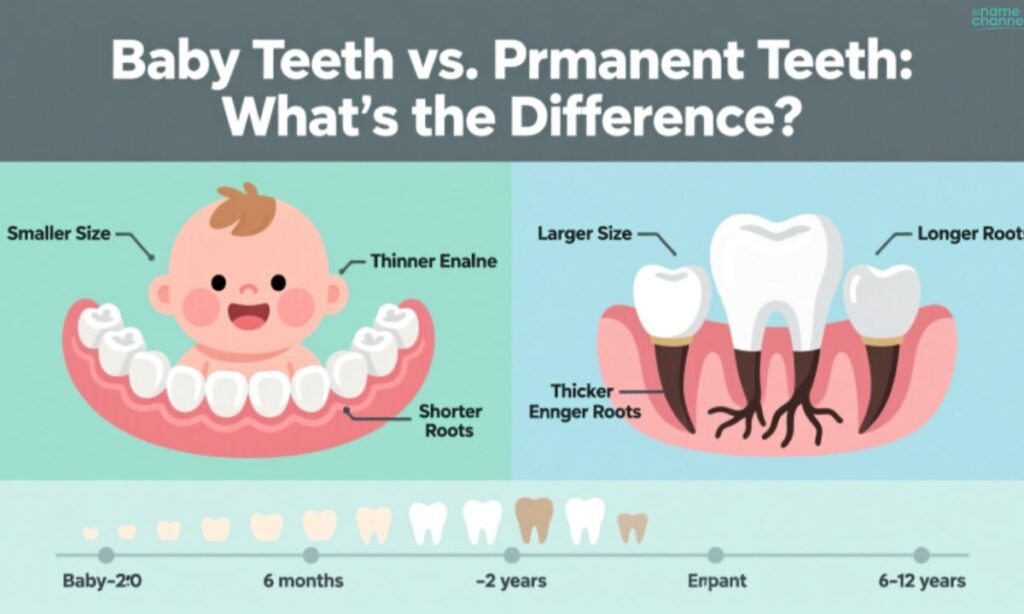
Baby teeth breakdown:
- 8 incisors (4 upper, 4 lower)
- 4 canines (2 upper, 2 lower)
- 8 molars (4 upper, 4 lower)
Baby teeth start falling out around age 6 and are gradually replaced by permanent teeth through the teenage years.
Frequently Asked Questions
Why do dentists use Teeth Numbers and Names instead of just saying the tooth name?
Numbers are more precise than names. For example, saying “molar” doesn’t specify which molar—you have 12 of them! Saying “tooth #19” pinpoints the exact tooth immediately, reducing errors and saving time.
What if I’m missing some teeth? Does the numbering change?
No, the numbering stays the same. Even if you’re missing a tooth, that number is still used to refer to that position in your mouth. This helps track your dental history accurately.
Do all countries use the same teeth numbering system?
Not exactly. The Universal Numbering System (1-32) is most common in the United States. Other countries use different systems, like the FDI World Dental Federation notation or the Palmer notation. However, the concept of standardized identification remains the same worldwide.
Why don’t I have all 32 teeth?
Some people naturally don’t develop wisdom teeth (teeth #1, #16, #17, #32), which means they’ll have 28 permanent teeth instead of 32. Others have had wisdom teeth removed. Both situations are completely normal.
Can teeth numbers help me understand my dental insurance coverage?
Absolutely! Dental insurance claims use tooth numbers to specify exactly which teeth received treatment. Understanding these numbers helps you review your benefits and verify that claims are processed correctly.
What’s the most important tooth in my mouth?
Every tooth matters! However, molars (#2-3, #14-15, #18-19, #30-31) do most of the heavy chewing work. Your front teeth (#6-11, #22-27) are crucial for appearance and speech. Losing any tooth can affect your bite and oral health.
How can I remember which tooth is which?
Start by remembering that #1 is the upper right wisdom tooth, and counting goes clockwise. Your front teeth (#8-9 top, #24-25 bottom) are in the middle of each jaw’s numbering range. With a little practice, it becomes second nature!
Do tooth numbers matter for kids?
Yes, but children’s teeth use a different system. Dentists often use letters (A-T) for baby teeth. Understanding your child’s tooth identification helps you follow their dental development and treatment needs.
Final Words: Empower Yourself with Dental Knowledge
Understanding your teet their names, numbers, and functions is more than just interesting trivia. It’s practical knowledge that helps you become an active participant in your dental care rather than a passive patient.
The next time your dentist mentions tooth #14 needs attention, you’ll know exactly which tooth they mean (your upper left first molar, in case you’re wondering). When you feel pain and can identify it’s coming from tooth #30, you can communicate that clearly during your appointment.
Your teeth work hard for you every single day biting, tearing, crushing, and grinding to help you enjoy food and nourish your body. They deserve your attention and care. By learning about your dental anatomy, you’re taking an important step toward lifelong oral health.
Remember: Your smile is uniquely yours. Every tooth, from #1 to #32, plays a role in making it function beautifully. Treat them well, understand them better, and don’t hesitate to reach out to your dental team with questions.

Ash is a naming specialist with 4 years of experience in creative branding, business naming, and identity crafting. She now shares her expertise on NameChannels.com, helping entrepreneurs, creators, and individuals discover unique, memorable, and impactful names.